AI: Grok Bot's Multi-Model Gambit, ChatGPT's Intelligent UI and Claude Cowork in the Cloud
You can order the same kind of articles for your own video to boost it on YouTube and Google. Just message the Telegram bot @sat_sit_bot. Articles with your video embedded are written and posted by the bot itself — on popular topical sites (no ads). Free trial — 50 articles.
· based on the channel Paul J Lipsky
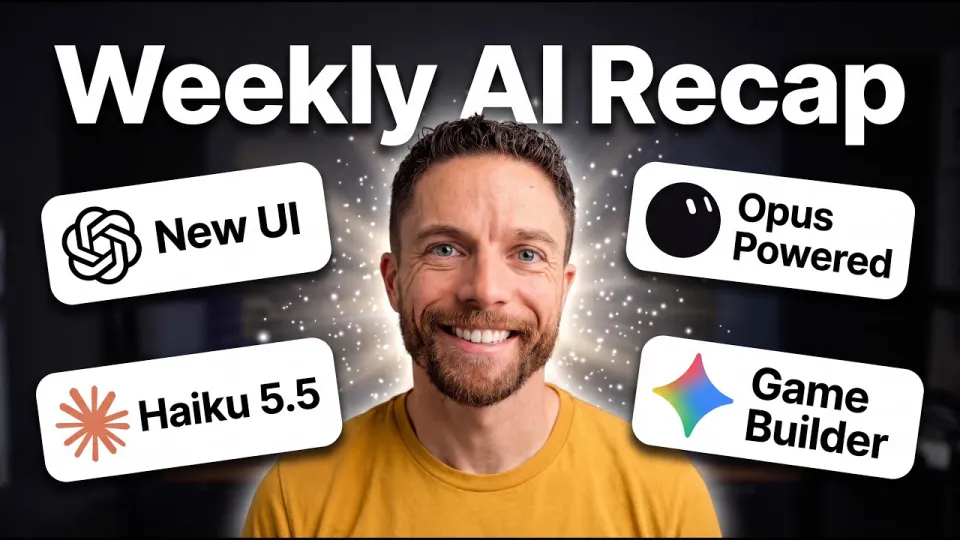
Grok Bot's plan to route work through Claude, Midjourney and Suno, ChatGPT's new Intelligent UI and Claude Cowork's move to the cloud are the three stories that define this week's AI news. The details come from Paul J Lipsky's weekly recap, which also covers Gemini plan changes and a hands-on test of Google Playground. Readers who want to try the workflow tool featured in the episode can register through Okou, the sponsor of the video.
The pattern across all of these announcements is the same: assistant products are becoming orchestrators rather than single models. Instead of one chatbot answering everything, the new generation of AI tools decides which model, image generator or music service should handle a request, then stitches the result together.
Grok Bot wants to borrow Claude, Midjourney and Suno
Grok Bot is being positioned as an agent that can call on third-party models and creative tools, including Anthropic's Claude, Midjourney for images and Suno for music, rather than answering only with Grok's own models. That is a meaningful shift for xAI's assistant, because it turns the bot from a chat window into a dispatcher that picks the best tool for each task.
The practical consequences are worth spelling out:
- Model choice becomes a routing problem. If Grok Bot can hand a reasoning task to Claude and a visual task to Midjourney, the quality of the answer depends as much on the router as on any single model.
- Creative work gets a single front door. A user could describe a campaign, get copy, images and a music bed without opening four separate subscriptions.
- Pricing and quotas get complicated. Third-party calls cost money, so limits on how often the bot can reach for Claude or Suno will matter more than raw token counts.
- Data handling needs scrutiny. Sending a prompt to an outside provider means a second company sees the request, which is a real consideration for business users.
One viewer described handing Grok Bot a folder of business videos and asking for a social media cut; the bot returned a voice script, and after the recording was fed back in, produced a result the viewer rated above the contractor work they had been paying for. That is exactly the kind of multi-step, multi-tool job that a routing agent is built for — and exactly the kind of job where a single weak link in the chain shows up immediately.
ChatGPT's Intelligent UI changes the interface, not just the model
ChatGPT's new Intelligent UI is a redesign of how the product presents itself, with the interface adapting to what the user is trying to do instead of showing one uniform chat box for every request. The name is the tell: the surface itself is meant to be smart, surfacing the right controls, tools and outputs depending on context.
For everyday users, the visible changes usually land in a few places: how tools and modes are selected, how generated artifacts such as images, documents or code are displayed, and how much of the interface is hidden until it is relevant. The risk of this approach is discoverability — features that appear only when the system guesses you need them are easy to miss, and users who learned the old layout have to relearn where things live.
The strategic logic is clearer than the cosmetic details. OpenAI has stacked up a large set of capabilities, and a flat chat window is a poor way to expose them. An adaptive interface is how you sell a suite without turning the product into a settings menu.
Claude Cowork moves to the cloud
Claude Cowork, Anthropic's collaboration-oriented agent product, is shifting to the cloud, which changes the operating model from something tied to a local machine to something that runs remotely. The immediate benefits are the familiar ones for cloud agents: work can continue when the laptop is closed, jobs can run longer than a local session, and teams can share the same environment instead of replicating setups.
The trade-offs are equally familiar. Cloud execution raises questions about where files live, who can access a workspace, and what happens to data after a task finishes. For teams evaluating Cowork, the checklist should include:
- Data residency and retention — where prompts, files and outputs are stored, and for how long.
- Access control — whether a workspace is per-user or shared, and how permissions are audited.
- Cost model — cloud agents that run unattended can burn through usage far faster than a chat session.
- Failure handling — what a long-running job does when a step breaks halfway through.
Anthropic's model lineup also came up in the same segment, with Claude Haiku 5.5 part of the broader update picture. Smaller, cheaper models matter disproportionately for agent products, because an agent that makes dozens of tool calls per task needs a fast, inexpensive model for the routine steps and a stronger one only for the hard decisions.
Google's Gemini plans and Nano Banana 2.1
Google's Gemini lineup is changing how its plans are structured, and the Nano Banana 2.1 image model is part of the same wave of updates. Plan restructuring is the less glamorous story but often the more consequential one: it determines which model tiers, storage and features a subscriber actually gets, and it is the detail most easily lost in a news roundup.
One point raised in the audience is worth flagging for anyone comparing tiers — higher-capacity plans can bundle a more capable Pro-tier model alongside large storage allowances, so the headline price is not the whole comparison. Buyers should check which model tier is included, how much storage comes with it, and whether the plan covers the image and video tools they actually use.
On the creative side, image models like Nano Banana 2.1 matter because image generation has become the most-used AI feature for a large share of casual users. Small version bumps in this space tend to focus on prompt adherence, text rendering inside images and consistency across edits — the things that separate a toy from a production tool.
The recap also includes a hands-on test of Google Playground, the experimental surface where Google exposes new model behaviors before they reach mainstream products. Testing these builds early is usually the best way to see where a model family is heading.
What the week's AI news actually signals
Three separate companies spent the week making the same bet: the assistant, not the model, is the product. Grok Bot reaching for Claude, Midjourney and Suno, ChatGPT rebuilding its interface around context, and Claude Cowork moving to remote infrastructure all point at orchestration as the competitive layer.
That has a few practical implications for anyone choosing tools right now:
- Judge the router, not the leaderboard. A product that picks the right model for a task will beat one that always uses its best model, even if the underlying benchmark scores are lower.
- Watch the limits. Multi-tool agents are priced by usage, and the ceiling matters more than the demo.
- Test with your own workflow. A folder of real files and a real brief reveals more than any launch video.
- Expect churn in interfaces. Adaptive UIs change weekly, so build habits around outcomes rather than button positions.
Common questions from the audience
The most-requested follow-up on this week's recap was a beginner-friendly walkthrough of Claude Code for people who do not write software, which suggests the gap between agent demos and everyday adoption is still wide. A second recurring theme was timing: one viewer noted that a new primary bot appeared in their account without warning, assumed something had gone wrong and deleted it, and now cannot recover it. Products that add agents to existing accounts should announce the change before it lands.
A third theme is verification. Enthusiastic reports of agents replacing paid contractors are useful signals, but they are single data points; anyone planning to restructure a workflow around a bot should run a side-by-side test on their own material first. And a fourth is plan arithmetic — subscribers comparing tiers want the model and storage details stated plainly rather than buried in a comparison table.
Conclusion
The through-line in this week's AI news is consolidation at the interface layer: Grok Bot assembling outside models, ChatGPT rebuilding its surface around intent, Claude Cowork moving to infrastructure that supports longer-running work, and Google reshuffling Gemini plans around Nano Banana 2.1. The models still matter, but the decisions users actually feel are being made by the routers, limits and interfaces wrapped around them. Paul J Lipsky's weekly recap is a useful way to track that shift, because it treats the product details — plans, quotas, account changes — as the news rather than an afterthought. If you want to test the workflow tool featured in the episode, you can sign up for Okou and see how it fits alongside the assistants covered here.
Key takeaways
- Grok Bot is reportedly being set up to call on outside tools such as Claude, Midjourney and Suno instead of relying only on its own models.
- ChatGPT is getting an "Intelligent UI" that changes how the chat interface looks and routes requests between models and tools.
- Claude Cowork, Anthropic's agent-style collaboration product, is moving to the cloud, which changes who can run it and how long jobs can last.
- Google's Gemini lineup is changing its plan structure, and the Nano Banana 2.1 image model is part of the same update cycle.
- The weekly recap from Paul J Lipsky also includes a hands-on test of Google Playground alongside the news roundup.
Source: Weekly AI Recap: GrokBot Just Did the Unthinkable, ChatGPT Looks Completely Different & More! · Markdown version
Questions & answers
What is Grok Bot's plan to use Claude, Midjourney and Suno?
According to this week's recap, Grok Bot is being set up to call on outside models and creative tools rather than relying only on Grok's own models. Claude would handle reasoning-style tasks, Midjourney image generation and Suno music, with the bot acting as a router between them. The practical effect is that a single request could produce copy, visuals and audio without the user opening separate apps.
What changes with ChatGPT's Intelligent UI?
The Intelligent UI is a redesign in which the interface adapts to the task instead of presenting one uniform chat box. Tools, modes and generated artifacts are surfaced based on context, which makes the product feel more like an app suite and less like a plain text window. The trade-off is discoverability, since features that appear only when the system expects them are easy to overlook.
Why does Claude Cowork moving to the cloud matter?
Running in the cloud means jobs can continue after a laptop is closed and can last longer than a local session, and teams can share the same environment. It also raises questions about where files are stored, who has access and how usage is billed, since unattended agents can consume far more than a chat session. Anthropic's smaller models, such as Claude Haiku 5.5, are relevant here because routine agent steps need to be cheap.
Should I upgrade my Gemini plan for the new model tiers?
Plan changes are worth checking carefully rather than judging by headline price. Higher-capacity plans can bundle a more capable Pro-tier model together with large storage allowances, so the comparison should include which model tier is included, how much storage comes with it and whether the image tools you use are covered. The same update cycle includes the Nano Banana 2.1 image model, which is relevant if image generation is a core part of your work.